
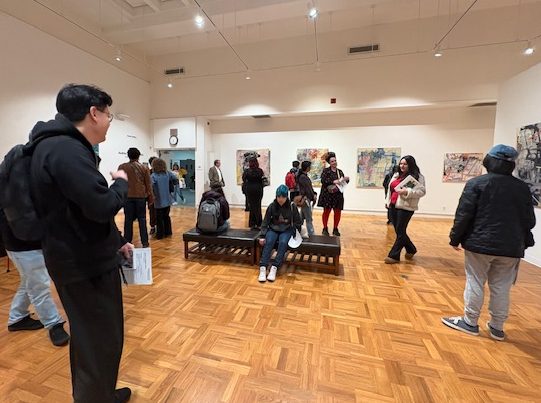
The Stan State University Art Gallery presents Poetic Cartography by artist Audrey Tulimero Welch. The exhibition explores migration, grief, family history and belonging through layered abstract paintings that use maps as both structure and metaphor.
For Welch, maps began as a way to navigate unfamiliar countries while living overseas for nearly 15 years.
At the open reception on Feb. 12, Welch explained that while mapping is central to her work, the exhibition also looks deeply into personal memory and loss.
“I use maps to translate the essence of a place, a person or experience without narrative,” she said.
Another important process she uses is layering, which often includes acrylic and plaster, which is a material connected to her Sicilian grandfather, who worked with plaster.
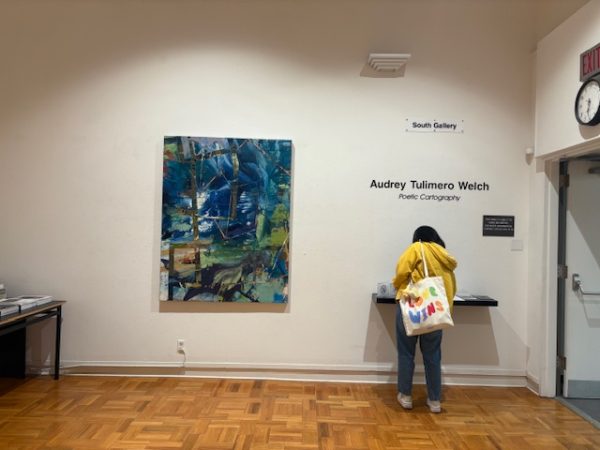
“It always startles me when painting and life come together so clearly,” Welch said.
Her piece Joseph’s Dream Coat was inspired by a dream she had after the death of her brother. In the dream, he returned wearing what she described as a dazzling multicolored coat, similar to the biblical story of Joseph’s coat of many colors. He returned to tell her he was okay.
“This piece feels powerful to me, and I hope for you, the viewer, you can step into it and experience and feel the power too,” Welch expressed.
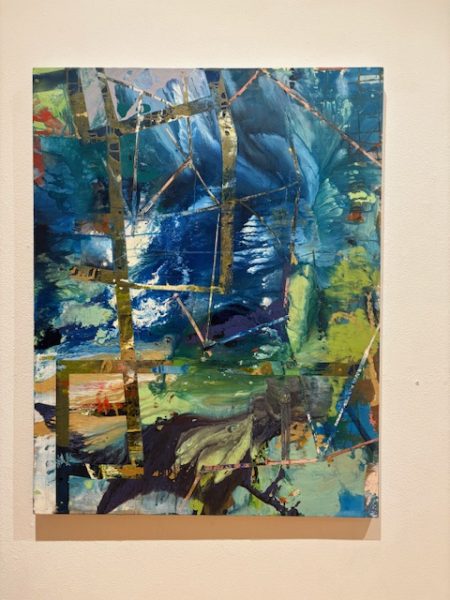
Before finishing it, she rediscovered a piece of canvas in her studio that had paint test strips her brother had done. Instead of painting over them, she chose to build the work around that memory.
The painting took nearly a year to finish and took a completely different direction by going from muted colors to more vibrant blue and green colors.
“I’m not mapping place in this painting,” she said. “I’m mapping an emotional response to a person and a specific memory.”
Brandon Bedolla Oliva (Freshman, History) attended the exhibit after encouragement from his humanities instructor and shares his thoughts on the paintings.
“Some of these paintings have really deep meaning if you look closely… some of these paintings felt really touching.” Oliva said.
He also shared that one of the pieces, My Aunties, resonated with him most.
My Aunties honors the women in Welch’s large Sicilian American family. She described growing up surrounded by “a boisterous group” of strong, fierce loving women whose presence shaped her identity.
The painting was inspired by a moment after her mother’s funeral, when one of her aunts firmly instructed an Uber driver to take care of Welch.
“I was sitting in the backseat and tears just started,” Welch recalled. “I knew only a mother could say those words.”
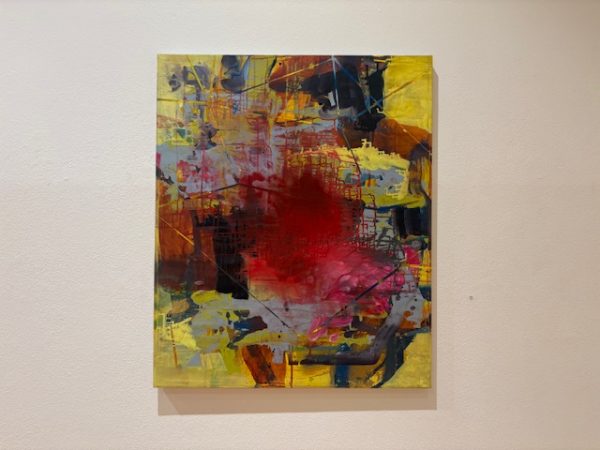
In My Aunties, bold electric colors like magenta and yellow reflect what Welch described as the loud and fierce love of the women in her family.
“I’m not trying to tell the viewer about something,” she said. “I’m inviting the viewer to live through something.”
During the reception, Welch joked about thinking she had invented the term poetic cartography. She then shared the definition:
“Poetic cartography is a multidisciplinary concept that explores the intersection of cartography and poetry to represent spaces through emotion, identity, and subjective experience. Where traditional physical maps fail to capture the human element.”
For example, her piece City of Aleppo, inspired by the Syrian refugee crisis, incorporates real refugee walking routes into the artwork.
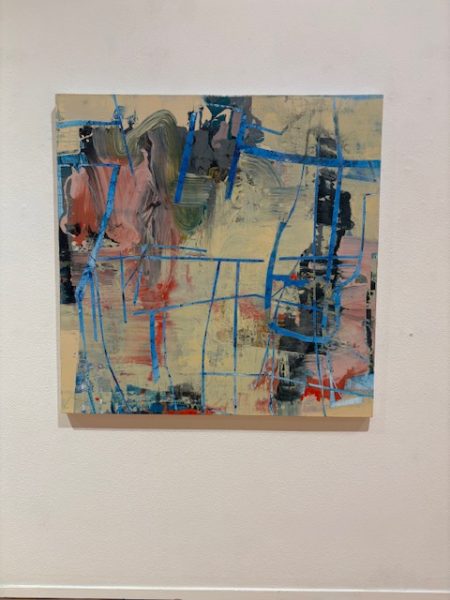
“I layered the maps on as a way for me to experience some kind of empathetic gesture of kinship through painting,” she explained. “I want to face their suffering, and try to surround it with life, with beauty, with hope.”
Ashley Corro (Transfer Student, Art) shares her impressions to the piece.
“The first thing that struck my attention was all of the pop of color,” Corro said. “The color palette, and also the bold, straight lines.”
Corro then mentions the piece, How We Move in Grace, about how the contrast between muted tones and vibrant blue creates a strong visual impact.
“The muted tones in the background really make the blue pop,” she said.
For students or community members interested in walking through the exhibit, they can visit the Stan State Art Gallery through March 13th.






Audrey Tulimiero Welch • Feb 26, 2026 at 5:42 pm
Beautifully written! It was an honor to speak to the art and art history majors who attended my opening. Kyara really captured the essence of the 20 paintings on exhibit. I hope many students and faculty will come see the show and allow the energetic and poetics works ti slowly reveal themselves. ATWelch
Signal Staff • Mar 18, 2026 at 4:27 pm
Thank you so much for reading our article. We enjoyed your exhibit and are grateful we were able to report on it. We really appreciate your feedback!