

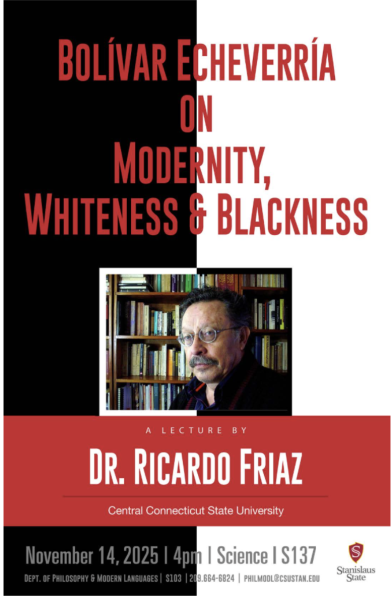
Dr. Ricardo Friaz, a Stan State alumnus and philosophy professor at Central Connecticut State University, visited Stan State on Friday, Nov. 14.
He conducted a lecture that explored the philosophical concepts of modernity and the cultural implications of whiteness and blackness in contemporary society.
Friaz began his talk with a thought-provoking question, “how or what should we be in today’s modernist world?”
He used this question as a foundation for the lecture, examining cultural representation and historical events such as slavery, while connecting these ideas to the present and to ongoing conversations about race and modernity.
Friaz defined modernity as “a set of behaviors discomposed or challenged in daily life,” expanding on the concept by showing how race and modernity are deeply intertwined.
“Race is a distribution between the poles of whiteness and blackness,” he said, referencing Bolivar Echeverria’s theories on social constructs and the historical forces that shape society.
Friaz noted that as modern ideals evolve, the acceptance of the “other” (people of different races and ethnicities) continues to grow, allowing for greater inclusivity within social and cultural systems.

He then introduced two key terms used to explain whiteness, blanquitud and blancura.
Blanquitud refers to “acting white,” often expressed through privilege and the ignorance that can accompany it.
Blancura, on the other hand, is a physical descriptor used to denote someone who is white without necessarily invoking racial or ideological meaning.
When addressing blackness, Friaz examined the historical context of slavery and the philosophical distinction between enslavement and self-ownership. He explained that a slave’s labor does not belong to them and therefore cannot generate personal profit. By contrast, ownership of one’s labor, being able to sell it freely is a foundation of capitalism.
Friaz expanded on these ideas by discussing how both whiteness and blackness exist on spectrums; there is “almost whiteness” and “almost blackness.” Within this framework, society positions individuals along these poles based on racial and cultural markers, influencing everything from land ownership to access to technology.
Ultimately, this system categorizes people as either white or black, with those who do not fit neatly into either group placed into subcategories that attempt to define their position within the broader racial hierarchy.
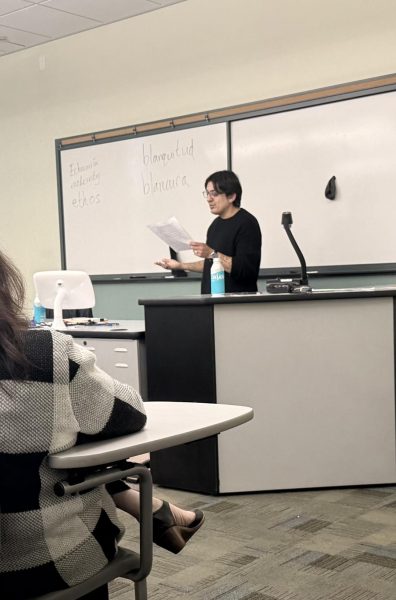
Students in attendance reflected on the lecture’s impact.
Gabriella Crawford-Willey (Junior, English) shared, “I thought the event was informative, and the speech broadened my perspective on modernity versus tradition. I hadn’t previously considered how the shift toward modernity impacts identity.”
Issac Barnes (Junior, Philosophy and Political Science) emphasized the importance of such opportunities on campus.
“I think opportunities like Dr. Friaz’s presentation are incredibly important. The university system is at its best when it provides students with the means to critically interrogate the structures that surround them while also encouraging them to reflectively engage with their own personal experience,” Barnes said.
Barnes added, “I find our university, like others, in dire need of more opportunities like these, especially those that foster interdisciplinary conversations between students and faculty. I can only hope that Dr. Friaz will be invited back in the coming years and that CSU Stanislaus will continue investing in similar events that make the undergraduate experience personally transformative rather than merely labor preparatory.”